Announcing our $11.1M Series ARead story
Back to Blog

How RISA prevents IV iron denials before submission.

A covered patient can still be routed to the wrong product. A clinically appropriate order can still miss the evidence the payer expects. RISA catches those mismatches before submission.
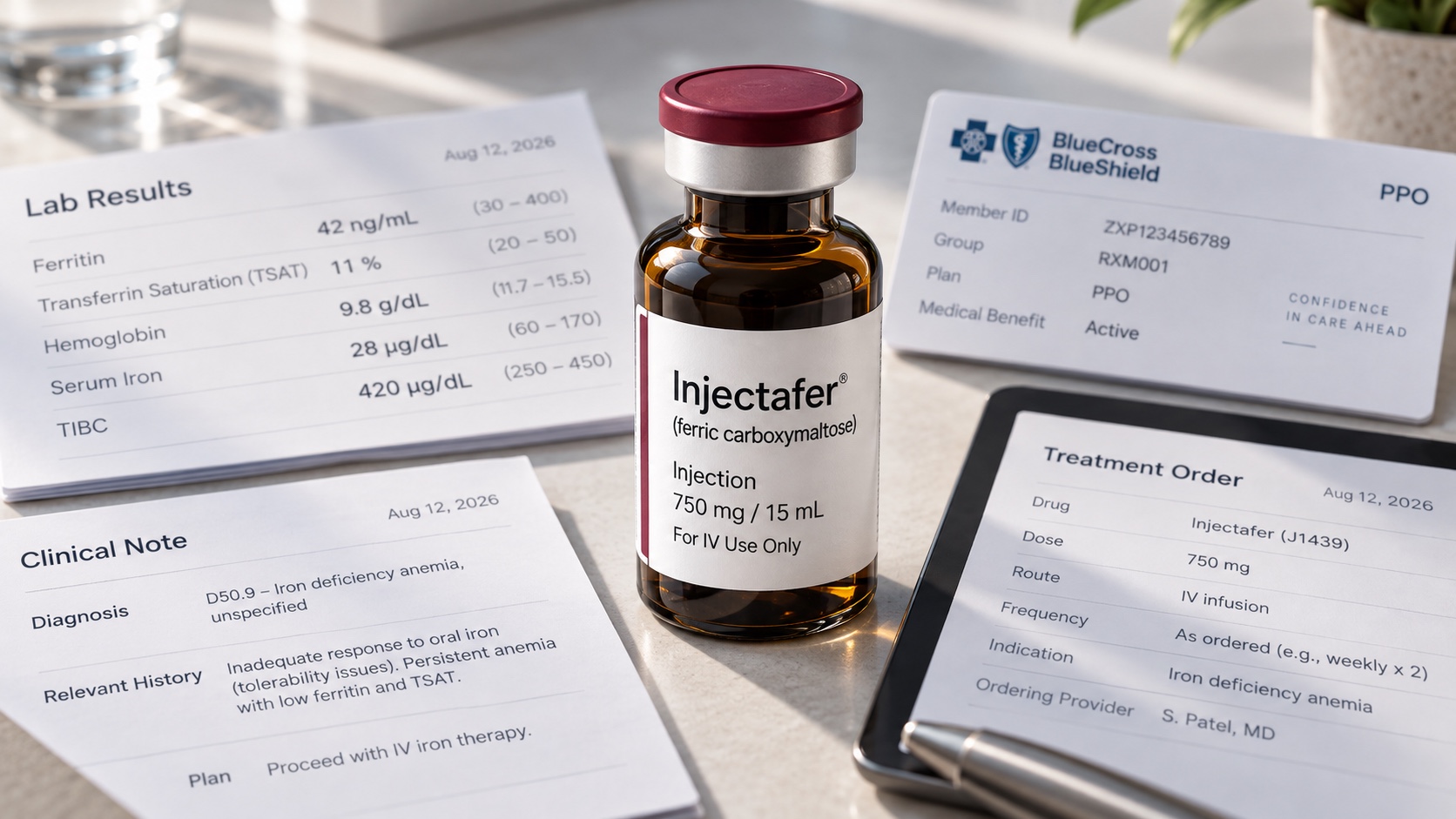
Injectafer vial beside lab results, a clinical note, insurance benefit details, and a treatment order
99.4%IV-iron first-pass approvalRISA internal analytics, analyzed IV-iron cohort
121K+IV-iron appointments covered
9,800+Potential denials preventedFlagged before downstream work

Snapshot through August 2026.

Why IV iron is easy to get wrong

One IV-iron order can fail in several different places.

IV iron is not one administrative decision. Coverage, product selection, diagnosis, prior therapy, and current iron evidence all have to line up before a request is ready to file.

50%
of respondents in an ASH-reported global provider survey named administrative burden as a barrier to IV-iron access.
101 respondents answered the IV-iron barrier question; the survey focused on iron access for patients with heavy menstrual bleeding.
10.3%
The one-year e-IRON report covered 477 unique consults. It identified a failed oral-iron trial that had not been documented as the most common denial reason.
The e-IRON workflow gathered indication, oral-iron history, and current labs before a hematologist reviewed the case.
8.4%
The same report said IV iron was denied in 8.4% of cases because required information, typically current lab work, was not provided.
In the earlier pilot, CBC and iron studies older than 30 days were treated as not current.
01 · ROUTE
Authorization pathActive coverage does not answer whether the order is NAR (no authorization required), a new PA, or an authorization on file.
02 · PRODUCT
Preferred product and step therapyA covered drug can still be the wrong product if preference, prior-product, or step requirements are not satisfied.
03 · DIAGNOSIS
Diagnosis and indicationThe code has to agree with the indication and chart, not simply exist somewhere on the order.
04 · PROOF
Medical necessity evidenceFerritin, TSAT, hemoglobin, iron studies, and prior treatment have to be present and current enough for the requirement.

How RISA solves the access problem

RISA turns every IV-iron order into a ready-to-file case.

RISA reads the order, matches current payer rules, checks the evidence, and writes the next action back. The result is fewer avoidable returns and less recovery work for staff.

01
Eligibility and coverage
Is the patient covered for this treatment date, under the right benefit?
What gets checked
  • Order context: product, J-code, dose, date of service, payer, plan, and provider.
  • Coverage: active eligibility and the applicable medical-benefit route.
Prevents
  • Working an inactive policy or stale coverage.
  • Building an authorization for a drug that is not covered under the expected benefit.
02
Diagnosis and indication
Does the coded diagnosis support the IV-iron indication and the rest of the chart?
What gets checked
  • ICD-10-CM: D50.0, D50.8, D50.9, and relevant oncology anemia contexts such as D63.0.
  • Clinical fit: diagnosis agrees with the indication, notes, and iron evidence.
Prevents
  • Filing a valid treatment with an incomplete or mismatched diagnosis.
  • Using D63.0 without the required neoplasm context.
03
NAR, PA and product pathway
Is authorization required, and is this the IV-iron product the plan expects?
What gets checked
  • Authorization route: NAR (no authorization required), a new PA, or an authorization on file.
  • Product rules: J-code, dates, units, preferred product, step therapy, and prior-iron requirements.
Prevents
  • Missed PA requirements, duplicate work, or expired authorizations.
  • A non-preferred product reaching the payer without prior-therapy evidence.
04
Medical necessity and iron evidence
Does the chart contain the proof needed for this patient, product, and requirement right now?
What gets checked
  • Current labs: ferritin, TSAT, hemoglobin, serum iron, and TIBC.
  • Treatment history: oral or IV iron response, intolerance, failure, and evidence freshness.
Prevents
  • Submitting stale labs or missing prior-treatment proof.
  • Filing an unsupported medical-necessity criterion instead of raising the exact query first.
FerritinIron stores
TSATTransferrin saturation and available iron
HemoglobinAnemia context
Serum iron + TIBCSupporting iron study
Prior oral / IV ironResponse, intolerance, failure
Last iron panelEvidence freshness

The threshold and evidence window come from the active clinical or payer requirement, not a universal hard-coded rule.

05
File, track and write back
File once the route, product, diagnosis, and evidence agree.
What gets checked
  • Submit: aligned payer answers and supporting records.
  • Close the loop: confirmation, status, authorization number, dates, units, and determination.
Prevents
  • The case resetting after submission.
  • Determinations and next actions are written back to the practice workflow or EHR.

Keep the order moving before the payer has to send it back.

RISA makes that outcome repeatable by checking coverage, product, diagnosis, and evidence before submission, then writing the next action back to the practice workflow.

Research references

Payer requirements can vary by plan, benefit, state, and effective date. Confirm the applicable policy before submission.

Back to Blog