.png)


_1.gif)

What got us here, won’t get us there.
For over a decade, the Directed Acyclic Graph (DAG) has quietly powered the backend of every major tech stack, from Google’s search infra to Netflix’s data pipelines, from Airbnb’s ML workflows to Meta’s content moderation engines.
DAGs enable us to decompose work, optimize parallelism, and ensure fault-tolerant execution across complex systems. In many ways, DAGs are the unsung heroes of modern software engineering — and the reason many SaaS businesses scaled to hundreds of millions in revenue.
But here’s the problem: Traditional DAGs were built for humans — not agents. And that’s about to become the bottleneck.
Introducing: Evolvable DAGs
At RISA Labs, we’re building for a world where AI agents collaborate with humans in real time — not just automate repeatable tasks, but adapt, evolve, and orchestrate complex workflows across industries like oncology, pharma R&D, and healthcare delivery.
To power that future, we needed more than Airflow, Spark, or Kubernetes.
We needed a self-evolving infrastructure — one that could:
- Orchestrate tasks with minimal human input
- Evolve node behavior based on feedback and data drift
- Rewire itself on the fly, while preserving deterministic logic
We call this system the Evolvable DAG.
What is an Evolvable DAG?
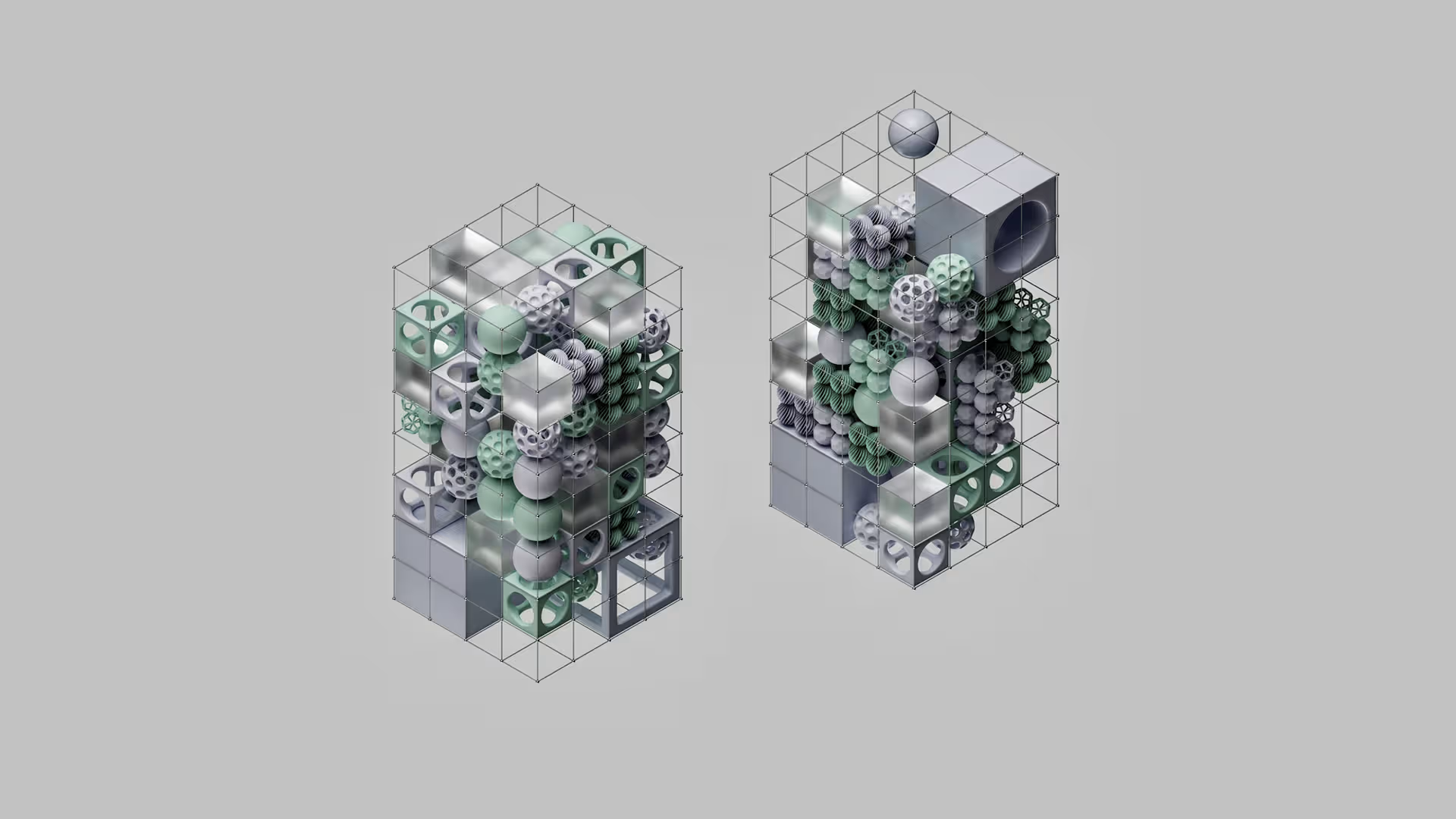
An Evolvable DAG is an AI-native evolution of the traditional DAG architecture. It retains the topological clarity and determinism of DAGs, but adds three critical capabilities:
- Decomposition Tasks are broken down into modular agents, with clear interfaces and contexts.
- Execution Workflows run dynamically, with runtime awareness of resource constraints, failures, and changing environments.
- Evolution: the agents within it — can evolve over time using techniques like DGM (Darwin Gödel Machine) and Markov Search Trees, guided by real-world signals, not static configs.
The result: a pipeline that doesn’t just run — it learns.
Why This Matters
Most enterprise workflows — especially in healthcare and life sciences — are brittle. They rely on hardcoded logic, tribal knowledge, and humans in the loop.
But the future of operational AI doesn’t scale with tickets or cron jobs. It scales with autonomous agents that can handle ambiguity, adjust to new data, and optimize outcomes — just like a great operator would.
The Evolvable DAG makes this possible, by acting as a living, learning operating system for your agents — across operations, research, and intelligence.
The Next Stack is Agentic
Unix taught us how to decompose. Docker and K8s taught us how to deploy. Spark and Airflow taught us how to orchestrate.
Now it’s time to evolve. The future belongs to those who build agent-first infrastructure — Evolvable DAGs are just the beginning.
What’s Next?
We’re deploying Evolvable DAGs across oncology clinical ops with OncoBOSS. This is the first glimpse into the BOSS Stack that powers RISA.
Follow BOSS Army for more dispatches from the future of Enterprise AI.

%20Firefly%20Upscaler%202x%20scale%201.avif)